The Week in Bloom

mustard.jpg

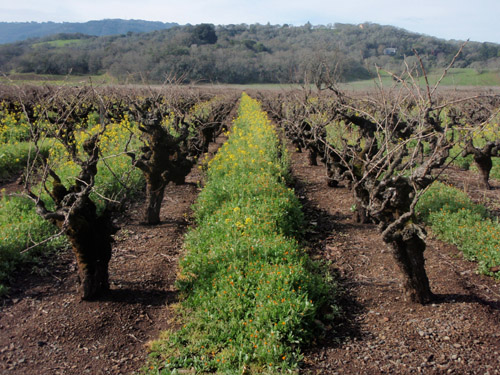
Mustard (Brassica juncea)

Bright yellow mustard riots in rows of south-sloping vineyards nearby. Meanwhile, wild honey bees have descended upon our Camelias, now drowsily drooping and dropping to the ground in earnest.

In the garden the favas are in full boom and look healthier than last year, having improved the soil:

favablossom.jpg
Vicia faba

Level at Rest

chairdoodle3.jpg

Level at Rest

I’m beginning to collect unbuilt chair ideas I’ve developed over the past few years in anticipation of designing a chair to make during my residency at Mildred’s Lane this summer. The chair will be used in new student housing and will be site-generated around parameters outlined in my evolving manifesto. In keeping with the radical frontier spirit of the project, Mildred’s Chair will be a rocker, made entirely of materials from the land surrounding Mildred’s Lane. I’ll also construct a simple field shop where the chair can be made by others in the future, anticipating improvements in the design over time. ???? ????? ??? ??

The chair above does not resemble the chair I have in mind for the project, but it is a good study of how a rocking chair could function. I call it ‘Level at Rest’, and it grew out of my idea to make a parabolic headrest to amplify evening sounds. ????? ????? The form was inspired by lifeguard stands and lifeboats on the South Jersey shore, with a white-washed upper and a darker base, painted level with the ground when the chair is at rest, like a waterline. ?????? ?????? ????????? I plan to build a small family of these rockers as soon as I can find the right client.

_uacct = “UA-4252294-1”; urchinTracker();

Kelp Report

kelpball1.jpg

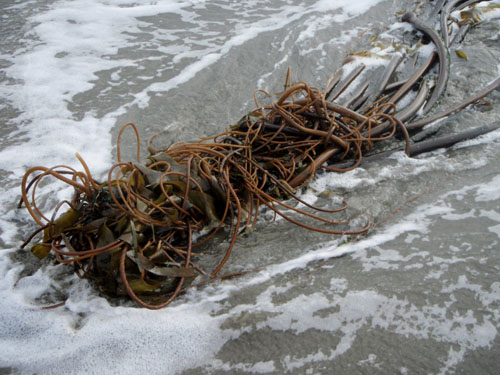
Late winter storms have deposited heaps of bull kelp along the shores over the past week. I had some success experimenting with kelp as a material for furniture last year but am not yet ready to take advantage of its availability in production. I’d love to hear from anyone who has seen kelp used in interesting ways.

Wood of the Gods

cedargrain.jpg

Deodar Cedar (Cedrus deodara)

“In the stands of Lodhra trees, Padmaka trees and in the woods of Devadaru, or Deodar trees, Ravana is to be searched there and there, together with Seetha. [4-43-13]”
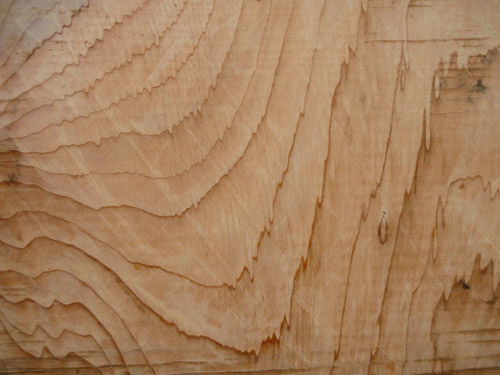
Nothing compares to the thrill of making the first passes with a sharp hand plane over freshly milled cedar to reveal the grain pattern of the tree. This is especially true when the wood carries such rich associations, brought to life under the blade by its sweet perfume, at once familiar and exotic. The same trees sheltered the ancient sages of the Western Himalaya, and is still worshiped as divine in the villages of Kashmir and Punjab. ????? ??????? ??? ??? Native to this region, the name derives from the Sanskrit devadaru, and translates as ‘divine wood’; essential oils are distilled from the heartwood and used in Ayurvedic medicine. Because of its natural resistance to rot and insects, deodar cedar was important to the spice trade and featured prominently in the construction of Hindu temples. The wood is supple and tight-grained and its intrinsic qualities inspire me to make something with a vitality and character befitting the noble legacy of the tree. ????? ?????

cedarstack.jpg

I spent a rainy Monday venturing down the coast to inspect logs and a few neatly stickered stacks of  deodar for a project I have in development- a small cabin whose interior and furnishings I’ll be designing and making over the next year and a half. I’d like all of the wood to sequence from the same tree as much as possible, and began the design process by discussing the potential yield of logs cut from ‘horticultural salvage’ with my friend Evan Shively. The tree was planted extensively in parks up and down the coast as an ornamental, and logs are occasionally available when a tree comes down. I will grade all material for the project based on how it is used/seen, featuring clear, wide boards for the floor and knottier ones for the furnishings and casework. ???? ???? I’ll need around 2000 board feet for the project, which will require at least two logs 36″ in diameter, about 16′ in length. Evan will cut the wood to my specifications, dry it in stacks as pictured above, and deliver the cured material to my shop for fabrication next year.

_uacct = “UA-4252294-1”; urchinTracker();

Emergent Patterns

fratishingles.jpg

The idea of ’emergence’ is usually associated with birds flying in flocks or insects swarming; a larger pattern emerges as the summation of otherwise unrelated, smaller patterns acting in unison. Emergent behavior is the best kind of unintended consequence, but is by nature impossible to predict. la ivermectina puede tomar un diabetico I try to find examples of emergent patterns to emulate in the built environment.

The shingles on my friend Richard’s house are a simple, elegant example: A wonderfully textured visual pattern is the fallout from a sequence of practical decisions played out with earnestness and conviction. ivermectin cream perianal use The same pattern would most likely not have resulted if the intention were to create a beautiful pattern of shingles, nor would it have functioned as well. too much ivermectin for pigs

_uacct = “UA-4252294-1”; urchinTracker();

The Week in Bloom

baytrunks1.jpg

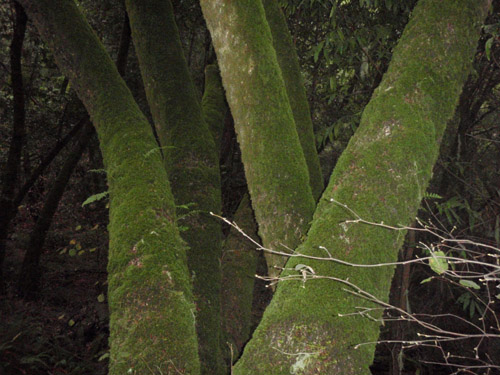
Ene and I hiked through the forest, along Willow Creek to the coast. Usually a gushing torrent this time of year, the creek was a barely audible gurlge beneath the mossy bays and redwood. Along the way,we spotted many new wild blossoms, including several that we could not identify. Please let me know if you can: Continue reading “The Week in Bloom”

Gradations of Comfort

mean_comfort2.jpg

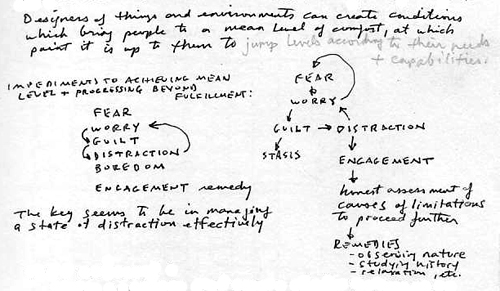
Impediments to comfort

As a person who designs and makes things that people use and live with every day, I’m continually intrigued by the concept of comfort. I find it easier to study extreme comfort as opposed to, say, the mechanics of a comfortable seat, so you may need to adjust your thinking in order to follow along. To me, ‘comfort’ is as much a mental state as a physical one.

There is very little research I’ve been able to find on ‘comfort’ per se (as opposed to ergonomics or human factors) related to design, so I have developed my own methodologies and hypotheses. My hope is that my ongoing research becomes manifest in the things I make. I’m very curious to know what resonates of the notes that follow:

A state of ‘comfort’ is one in which one’s sense of self in a particular time and place approaches completeness. This is often initiated in contrast to impediments of the same (see graph above).  Gradations of comfort:

  • safe
  • satisfied
  • content (mean level)
  • fulfilled/attentive (transition)
  • self-realized
  • transcendent
  •  epiphanic

My hypothesis is that beyond the ‘mean level’ of contentment, one seeks a state of comfort physically in order to extend one’s consciousness or mental awareness into a larger context. In this way, people may use ‘comfort’ as a tool to achieve creative breakthrough, beginning by defining for themselves what constitutes an ideal state of comfort and how it may be attained. Designers of things and environments can create conditions that bring people to a ‘mean level’ of comfort, at which point it is up to the individual to jump levels according to their needs and capabilities. *

*For many people, an ideal state of comfort involves transitioning through a state of ‘discomfort’.