Casting in Bronze

bronzepour.jpg

pouring molten bronze into molds for our series of sculptures for Sunnyside Conservatory in San Francisco

We were thrilled to witness the bronze casting of our series of sculptures for the Sunnyside Conservatory Menagerie yesterday at Berkeley’s Artworks Foundry. It has been an honor to collaborate with artisans skilled in the ancient art of lost wax casting and opens up a world of possibilities for our future public projects. While the technique is more resource intensive than any we have employed to date, it has me thinking about the trade-offs and potential rewards of purely aesthetic experiences over a longer time frame. I wonder if there is a metric to compare the impact of things designed to stimulate the public imagination against the effects of the extraction of resources that brought them into being.


fine dry sand is aerated to coat the silica-ceramic molds (see above) for casting bronze

Geography of Craft

delaware-ecoregion.jpg

map of the bioregions relating to the Delaware River and its tributaries, including portions of Pennsylvania, New Jersey, New York, Delaware, Virginia and Maryland (from The Encyclopedia of Earth)

As a woodworker, I make a habit of studying the bioregion for site specific projects to get a sense of scale and context, with an eye towards material provenance, land use and ecology. In preparing for my residency at Mildred’s Lane, I was pleased to find a detailed atlas of the bioregions affecting the Delaware River and its extensive tributaries at the website of The Encyclopedia of Earth. Mildred’s Lane is within the Lower Catskills bioregion, the dark green area at the Northeastern corner of Pennsylvania where it borders New York (top right of the above image), described by The Encyclopedia of Earth website as follows:

62e. Low Catskills
The Low Catskills (62e) is a forested and highly dissected ecoregion less than 5 miles (8 km) wide in northeastern Pennsylvania. Here, the Delaware River has deeply entrenched into the glaciated Appalachian Plateau, creating cliffs and steep-walled valleys. Many high-gradient tributaries occur and stream organisms associated with riffles are common. Topography is rugged for this part of the commonwealth and local relief ranges from about 450 to 800 feet (137-244 m). Crestal elevations are from approximately 1,300 to 1,800 feet (396-549 m) and are high enough to insure a short growing season of about 130 days, varying according to local topography and slope aspect.

The soils of Ecoregion 62e are mostly Inceptisols. Most formed on Olean Till and some developed on Quaternary alluvium. They overlie nearly horizontal, Devonian age sandstone, siltstone, and shale of the Catskill Formation. The soils are characterized by stoniness, shallowness, low fertility, and acidity, which, together with the rugged terrain and brief growing season, make the area best suited to woodland (Higbee, 1967). The natural vegetation was mostly Northern Hardwoods (dominants: sugar maple, yellow birch, beech, and hemlock) (Cuff and others, 1989, p. 52). Some wetland vegetation occurs on poorly drained sites, and northern rock plants grow on the Delaware River cliffs in northeastern Wayne County (Erdman and Wiegman, 1974, p. 50).

The boundary between Ecoregion 62e and the less dissected Northeastern Uplands (60b) occurs at the forest density and topography break shown on the Scranton Ecoregion 62e extends across the Delaware River into New York, where it becomes much more extensive. 1:250,000-scale topographic map; Ecoregion 62e is much more rugged and wooded than Ecoregion 60b

The Week in Bloom

butterfly.jpg

Zebra Swallowtail butterfly (Eurytides marcellus)

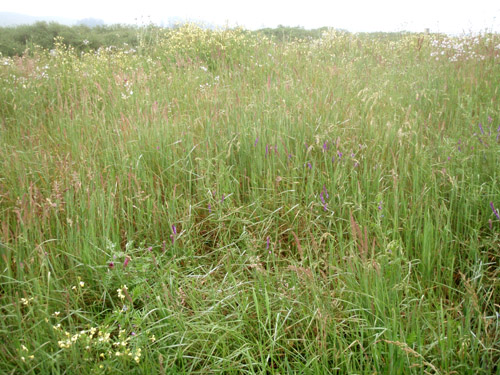
Spring’s acceleration has leveled off as the solstice approaches. Trees are all in full leaf, and it’s looking like a potential bumper crop year for apples and pears. The hay has been cut, dried and baled on nearby farms and the sheep are ready for shearing. Most grazing meadows still have lush pockets of green but are rapidly turning straw gold, the earth hardening underfoot. The summer season is in full swing in West Sonoma, with boats atop cars and trucks on the roads, weaving their way to the waterways around sporadic swarms of brightly jersey-ed cyclists.

sheep21.jpghaysign.jpg

sheep are ready for shearing about the same time the hay is cut and baled

caterpillar.jpg

Around the Wowhaus compound, the Salt Marsh caterpillars are a common sight, alongside a host of butterflies like the Swallowtail (at top)

peacock.jpg

While cycling the Bohemian Highway, I spotted this peacock, a now familiar anomaly.

Watersheds and Bioregions

watershedmap2.jpg

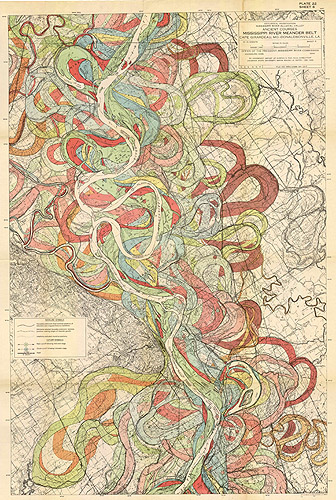
The Alluvial Valley of the Lower Mississippi River, map 6/15, Army Corps of Engineers, 1944, Harold Fisk, chief cartographer

Documenting the seasonal cycles over the past few months (see my Week in Bloom postings) has me thinking a lot about bioregions and watersheds as the most appropriate scale for human interaction with the natural world and with each other. I think of vernacular forms in the built environment- domestic architecture, traditional craft- as the most consistent, universal kind of natural/cultural expression of any bioregion. In many ways, my activities designing and making things, and the general thrust of this site, are attempts to model a contemporary, bioregional credo. My ideas for projects typically stem directly from the inherent natural/cultural attributes of a place, beginning with straight-up observation.

I continue to look at maps and data related to the upper Delaware River and Lower Catskills  bioregion as I prepare to test my Deepcraft approach as a resident artist at Mildred’s Lane next month. In the course of my research, a friend sent a link to a website dedicated to experimental geography, called Radical Cartography, that includes a series of beautiful watershed maps of the entire Mississippi River  (see above) made by the Army Corps of Engineers in the early 1940’s (exactly when Harlan and Anna Hubbard were drifting down its length in their home-made Shanty Boat). Called Mississippi Meanders, the series of 15 maps details drainage patterns of the river’s basin from Southern Illinois to Southern Louisiana, where it drains into the Gulf of Mexico. I hope to make a very small scale map of the watershed comprising Mildred’s Lane and its surroundings, with layers reflecting plant life and material provenance.

Shanty Boats and Scow Schooners

scowschooner3.jpg

the scow schooner Annie L, built in 1900 by Emil Munder, unloading hay in San Francisco

As hay bales begin to dot the fields I’m reminded how little the landscape of West Sonoma County has changed since the late 19th century, when scow schooners still sailed down the rivers to deliver cargoes of hay, timber and other agricultural goods harvested nearby to the City on the Bay. It doesn’t take much effort for my thoughts to drift to boat-building and water-born voyages, especially as I prepare for my residency at Mildred’s Lane, near the Delaware.

shantyboat.jpg

I’ve always preferred work boats to yachts, especially simple barges like the scow schooner pictured at top, designed for shallow draft and to carry a heavy load under sail. The most primitive vessel of this type, a shanty boat with no power train, designed to drift down a river, is prosaically described by Harlan Hubbard in his classic book, Shanty Boat (1953, Dodd, Mead & Company), which I am currently re-reading  and highly recommend. The memoir chronicles five years of the lives of the artists Harlan and Anna Hubbard, who spent two years building a boat and three years drifting it down the Ohio and Mississippi to New Orleans:

“I had no theories to prove. I merely wanted to try living by my own hands, independent as far as possible from a system of division of labor in which the participant loses most of the pleasure of making and growing things for himself.” (excerpt from ‘Shanty Boat’ by Harlan Hubbard (1953, Dodd, Mead & Co.)

This all has me revisiting my old notes and boat-building literature for the right vessel to build to meet the challenges of nearby waterways, which is very much my default mode.

shantydrawing.jpg

sketch of an idea from 1999 for a light weight, inexpensive ‘collapsing barge’ to reach distant waterways overland

Future Classic?

cardboardsurfboard.jpg

looking through the translucent, fiberglass/resin skin to the honeycombed, cardboard core of one of Mike Sheldrake’s prototype surfboards

In terms of the triad of beauty, performance and workmanship, Mike Sheldrake’s cardboard surfboards transcend the impressively vast exposition of mostly ‘DIY-for-DIY’s-sake’ projects and demonstrations at this year’s Maker Faire. Posing serenely amidst whirring gizmos and gadgets, the ultralight, translucent boards with the honey-combed, cardboard core struck me not just for their sublime simplicity, but because they were perhaps the only project making reference to the natural world. Their inspiration clearly derives from a desire to connect with the waves under one’s own power, by one’s own hand.

My friend Donald Fortescue and I toured the Maker Faire in San Mateo yesterday, grazing and gleaning as we spiraled around the perimeter fairgrounds into the core of airplane hanger-scale exhibition halls. We found ourselves fully saturated after a few hours and left for a picnic lunch by the salt flats overlooking the Bay. Donald, who chairs the wood/furniture program at California College of the Arts, lamented the conspicuous lack of connoisseurship guiding current trends in craft culture. I agreed, and would add: Things last when they are loved; things are loved when aesthetics drive the functional program from the moment of conception on.

I applaud the spirit of exuberant experimentation and decentralized invention sparked by the Maker Faire, but will be curious to see what emerges as a Future Classic as open source hacking shifts its focus to material culture.

The Week in Bloom

windlass1.jpgwindlass2.jpg

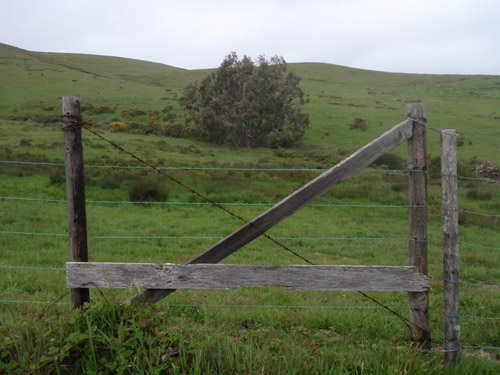
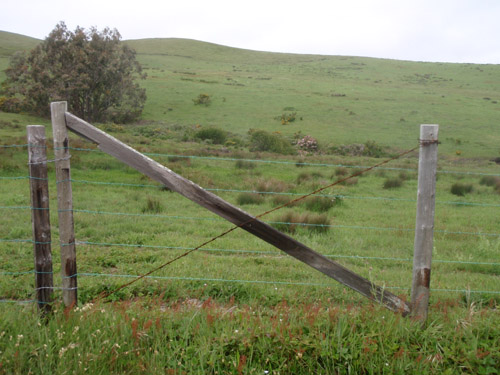
elegant windlass at each pair of posts, framing a gateway

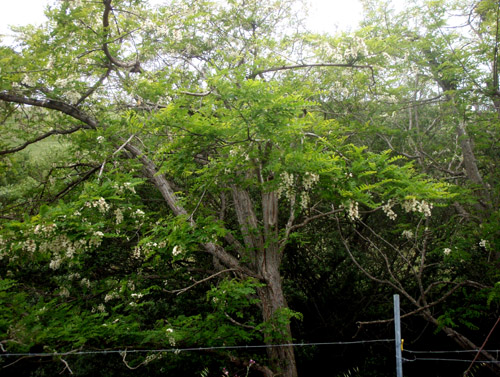
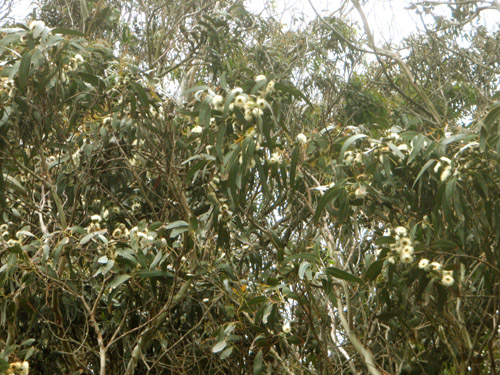
The only sounds punctuating my bike ride to the coast along the quiet, eight mile stretch of Valley Ford-Franklin School Road were the sweet song of the meadowlark perched on fence posts and the eerily creaking eucalyptus in the wind. As I climbed the long inclines south, between Estero Americano and the mouth of Tomales Bay, I made pause at each crest to catch my breath and sit for a while, staring out at the vast grazing land to either side before descending. I noticed how the ranchers have made breaks in the fencing at the high points, gateways large enough for a truck, framed by paired posts, typically joined and made strong by an elegantly simple windlass. Each rancher has his own style, and it seems a point of pride to not copy your neighbor. I found myself drawn to the older styles, evidenced by the patina on the wood and barbed wire, and the general economy of material (see above) and skill of execution. Along the way, I made note of these new blooms by the road:

locustbloom.jpg

black locust

eucalyptusbloom.jpg

eucalyptus

culvertbouquet.jpg

a typical ‘culvert bouquet’