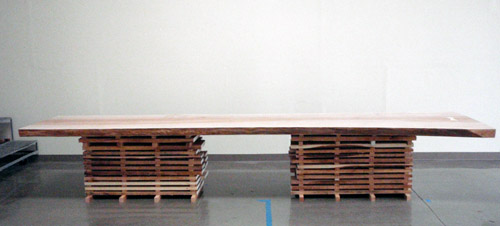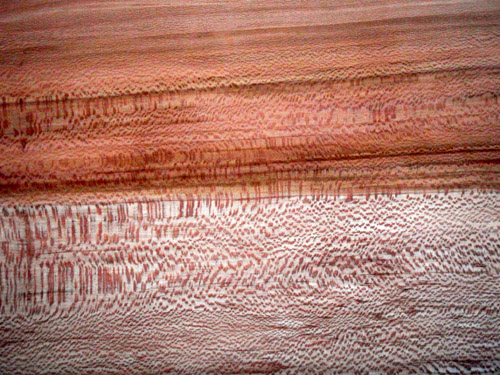
Two identical bases of green pecan, ready to receive the top, a giant slab of sycamore.
Whenever I design and make a new piece of furniture, I’m always keenly aware of how it will age, and how the piece might transform over time to encourage and support future, as yet unforeseeable patterns of use. I’ve been collecting choice local woods over the years, all neatly stickered in the barn, so my design process usually begins with rummaging through my piles for inspiration, making measurements and drawing directly onto the wood with white chalk. My primary criteria at this early stage is whether the piece of furniture I have in mind is the appropriate final destination for the wood- will it do the tree justice? I’ve always thought of my furniture as a way of extending the life of a tree, as a way of simultaneously storing and appreciating wood by putting it to good use; living daily life as an extension of making.
As I continue to collect and store local woods, and especially as I begin to mill trees myself, I’m becoming more attuned to the value of locally sourced, well-sawn, air-dried wood as a commodity. An increasingly scarce resource, fine wood is a good investment and increases dramatically in value, especially if it has the added cache of ecological responsibility, streaming from the urban forest, or as ‘horticultural salvage’. Because handmade furniture ultimately needs to compete in the marketplace with an increasingly sophisticated range of mass-market comparables, it can be challenging to offer a price point in proportion to the value of the material itself, which is a dilemma, even if the quality of the finished product is markedly higher. This is especially the case when ‘studio furniture’ needs first and foremost to meet rigorous functional, as well as aesthetic requirements.
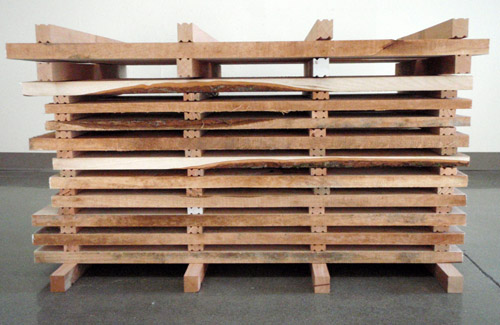
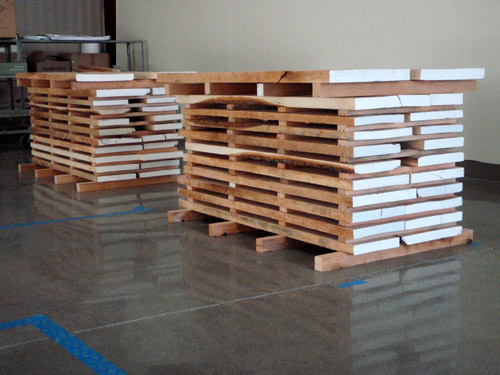
I milled grooves into the stickers for better air flow and to allow for movement.
While my way of thinking about wood-as-commodity has lived quietly in the background of most of my furniture design to date, I’ve been wanting do make a new body of work where the concept is front and center, both in the process of making and in the process of using the furniture. To this end, I’m grateful to my friend Cindy Daniel, who commissioned a ‘Demonstration Table’ for Shed, her Healdsburg-based café/retail/community hub offering local foods, goods and quality wares. Shed is Cindy’s contemporary spin on the traditional country mercantile store, and I’ve enjoyed working with her over the past two years designing interior scenarios for the new building currently under construction, a large, open air metal structure designed by Mark Jensen.
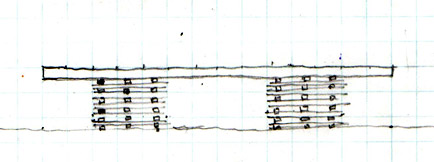
My original thumbnail sketch for the Stickered Table
As much as my Demonstration Table for Shed will serve as a gathering place in the café, it doubles as a process piece for the duration of the enterprise, establishing a kind of invented tradition. The table’s base consists of two nearly identical stacks of green pecan wood I recently milled from a dying tree, neatly stickered to allow the wood to naturally air-dry. The table’s top, a massive slab of sycamore, rests on top of the two piles, acting as a gravity clamp to keep the material from cupping. I milled V-grooves into the stickers to allow for better air flow and to decrease friction as the boards inevitably shrink. After one year, when the stock is adequately dry, the top will be lifted and the material removed and converted into functional wares for Shed, either to be used in the café or sold as product to customers. This first batch will likely make small table tops for the Shed café, slated to open in October 2012.. The two bases will then be re-constructed, stacked from freshly milled wood each year, that will in turn be made into a small production run of whatever item surfaces in the course of its drying.
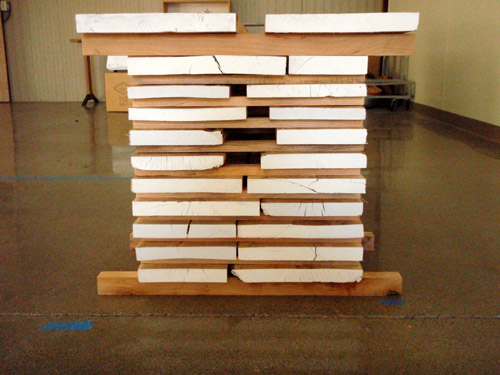
I typically shellac and wax the ends of boards to prevent undo checking.
I like the idea of adding an element of ‘crowd-sourcing’ to the design development of an annual product, taking advantage of a constant flow of people gathered around the table while the material slowly cures beneath. I also look forward to maintaining an ongoing relationship with Shed as a kind of artisan-in-residence, collaborating with Cindy to design products that exemplify the Shed ethos.
Please click here to see the table with the top installed.